So about two weeks ago I started my MA in Writing – ever since, I've had complete and total writer's block. Stage fright, I guess, or maybe the realisation that I have to take it seriously now. Either way, the suffering got pretty intense, and I've been dragging myself through my everyday activities like a wounded animal; after a while, I got so sick of myself I decided I had to do something, so I picked up a "how to write every day" type book and went straight to the exercises. I started yesterday. I'm not sure how much shame there is in learning to write again and treating it like physical exercise, like jogging maybe (which was the suggestion in one of the books I read and which, incidentally, I should start doing again too) – either way, it seems to be what I need to do.
12 October 2012

02 October 2012
Aspiration / And God is Empty [Poem]
The sitting softens with time
yet the focus on it hardens.
The gluteus has melted away until there is an impression of sitting on bone
softly
delicately
like cracking an egg.
Gentle hands sieve out the cracked shell
and what may have remained of a dead thing
Surrounding the roaring tube
that jitters like a vacuum
the hips are spread and from them ooze the protruding legs
with this insistency that bones have of remaining straight.
When the face falls sideward you half expect a tear rolling down its surface
slaloming through the beads of sweat
and burying itself on the floor.
yet the focus on it hardens.
The gluteus has melted away until there is an impression of sitting on bone
softly
delicately
like cracking an egg.
Gentle hands sieve out the cracked shell
and what may have remained of a dead thing
Surrounding the roaring tube
that jitters like a vacuum
the hips are spread and from them ooze the protruding legs
with this insistency that bones have of remaining straight.
When the face falls sideward you half expect a tear rolling down its surface
slaloming through the beads of sweat
and burying itself on the floor.
29 September 2012
Recyclers
Though it is now more obvious than a few years ago, I (along with seemingly most of my generational peers) have spent my youth so far in a limbo, an ideological limbo in which any movement, any attempt at creation and at stuffing meaning into the more or less tactile carcasses of dress, of expression, of speech, of the use we make of our senses, seems doomed from the start to go up in smoke, as there is nothing it can adhere to, nothing it can rub against, and we twirl through the motions of spirit one failed, meaningless, utterly self-referential act after another, so postmodern it has become aware of nothing but itself, thinking that from its patch-worked bowels it can extract something, anything, of value if it only digs, squeezes, pulverises enough. But really, there is nothing, because there was nothing to begin with. We've exhausted the limited (but seemingly endless) heap of countercurrents and acts of rebellion, as well as the currents we chose to be rebellious against, so far even that we started assimilating parts of them in a desperate attempt at a new act of defiance; but the irony only got us so far, and distinguishing between what we meant and what we refused became increasingly muddy, until it became nothing at all. Now, we find ourselves stuck in a cycle of referentiality, all we are left with is the attempt to take over what has been, what used to make sense in the context of its own time, of its own place, and struggle to make it our own, to corrupt it according to our needs, and to do so while at all costs avoiding to let ourselves see that all we are doing is vulgarising it, contaminating with our own lack of meaning, of fulness, we are littering the streets and pages with empty concepts because, when ripped from their original context, their original propagators, they are nothing but shells we adorn ourselves with in an attempt to stand out in a mass that is adorned with the same shells, occasionally showing a very slight variation in shading or shape, but shells nonetheless. We all jingle the same, empty tune, and we're loving it because, hey, it's our generation's birthright to take and ruin, to colonise and misunderstand, to cut the filaments that fed the heart and dangle corpses from our ears, we are the recyclers and the conquistadores of the past, we are a band of toddlers obsessed with DIY and disgusted with history, in fact, we have no scruples about robbing signs, symbols, words of their context, we are a-contextual and the world better follow our lead, the past needs to be cut into pieces and distributed among us so that we may make use of what cannot be discarded without being recycled into an identity, so we don't let it sleep but take it with us into the future, we call it innovation, no, wait, we call it being unique.
We don't have a movement because movements are for suckers, for those whose aspirations are too linear, and, perhaps the one thing that sets us apart is this recycling of what used to be and fashion it into new identities. Our generation is circular.

We don't have a movement because movements are for suckers, for those whose aspirations are too linear, and, perhaps the one thing that sets us apart is this recycling of what used to be and fashion it into new identities. Our generation is circular.

26 September 2012
Mermaids
I'm not sure how this occurred, but on our way into town this morning, the conversation that usually accompanies our walks turned from the physical (sharks and crocodiles, and why they're aesthetically vile, on top of being nothing but stomachs with teeth) to the fantastical, namely mermaids and why they're clearly mammals. Though this is more of a debate you have late at night when you run out of ideas and less nerdily whimsical topics to discuss, I have often had to listen to people loudly (fuelled by wine) exclaim that mermaids, if they existed, would fall under the category of fish, with a reproductive system to match. This theory never appealed to me, perhaps due to a mammalian narcissism, perhaps because it seems wrong that something based so closely on human proportions would lay eggs and produce offspring counting anywhere between two and three digits, and I kept insisting that mermaids have wombs.
And today, it finally occurred to me why this was closer to making sense than I thought: it was pointed out to me that sharks move their rear fins sideways, like most fish (excluding those flat ones that dwell on the bottom of the sea like predatory pancakes), but that sea-mammals, like whales and dolphins, wag their tails up and down, fanning the water like ancient Egyptian servants as they swim.

The reason this is so, we figured (we could probably have read this up in any book on marine biology, but we didn't have one at hand, so guessing was the best we could do), is because fish have a skeleton much different to that of mammals: they do not need to accomodate a womb like we do, and their skeletons go straight through their bodies, almost as though they were on a skewer, with bones sticking up and down, which means that a sideways motion makes the most sense for them.

For mammals, however, such a motion would prove very difficult, even underwater, as their skeleton is mostly dorsal, i.e. located along their backside. Additionally, whales, as well as dolphins, don't seem to have bones in their rear fins, whereas sharks do; mammalian rear fins therefore seem to really function according to more of a fanning mechanism, used for propelling and steering, whereas those of fish, along with propelling, might serve more of a directional function, like a rutter on a boat.

But all of that pseudo-biology aside, what really matters about this is, of course, the thing whose existence is uncertain at best: the mermaid. In their traditional representation, mermaids are "seen" swimming moving their back fin (the fishtail part) up and down, like dolphins and whales, rather than sideways – and, surprisingly, this makes a lot of sense. If they are based on human anatomy, at least partly, it would make very little sense for their skeletal composition to suddenly undergo a complete change as we go from their human part to their fishtail: seeing as their human upper body is depicted as normal, with a spinal cord and ribs, their fishtail would, to make sense, have to be composed like that of a dolphin (or whale, if we're talking about a particularly heavy-set mermaid), with a dorsal spinal cord that extends further than that of humans, all the way down to the feet, which, in this case, are flattened to the state of fins. Imagine a human with two boneless legs sown together (ew) and a very long, straight spinal cord that traverses this sown-together construct, plus two human feet, flattened to they look like fins, with the bones of the feet stretched like gum until they are very thin and serve to give shape to the thin skin of the fin-feet. Or just look at a pretty mermaid.
Either way, all you need to do now is get used to the idea of a pregnant mermaid. Fortunately, it seems it would be much easier for them to regain their figure after pregnancy than for us, what with non-stop workout your abs get simply from swinging your fins up and down.
And today, it finally occurred to me why this was closer to making sense than I thought: it was pointed out to me that sharks move their rear fins sideways, like most fish (excluding those flat ones that dwell on the bottom of the sea like predatory pancakes), but that sea-mammals, like whales and dolphins, wag their tails up and down, fanning the water like ancient Egyptian servants as they swim.
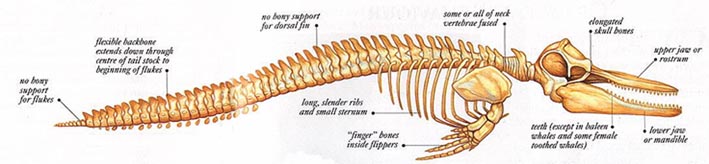
The reason this is so, we figured (we could probably have read this up in any book on marine biology, but we didn't have one at hand, so guessing was the best we could do), is because fish have a skeleton much different to that of mammals: they do not need to accomodate a womb like we do, and their skeletons go straight through their bodies, almost as though they were on a skewer, with bones sticking up and down, which means that a sideways motion makes the most sense for them.

For mammals, however, such a motion would prove very difficult, even underwater, as their skeleton is mostly dorsal, i.e. located along their backside. Additionally, whales, as well as dolphins, don't seem to have bones in their rear fins, whereas sharks do; mammalian rear fins therefore seem to really function according to more of a fanning mechanism, used for propelling and steering, whereas those of fish, along with propelling, might serve more of a directional function, like a rutter on a boat.
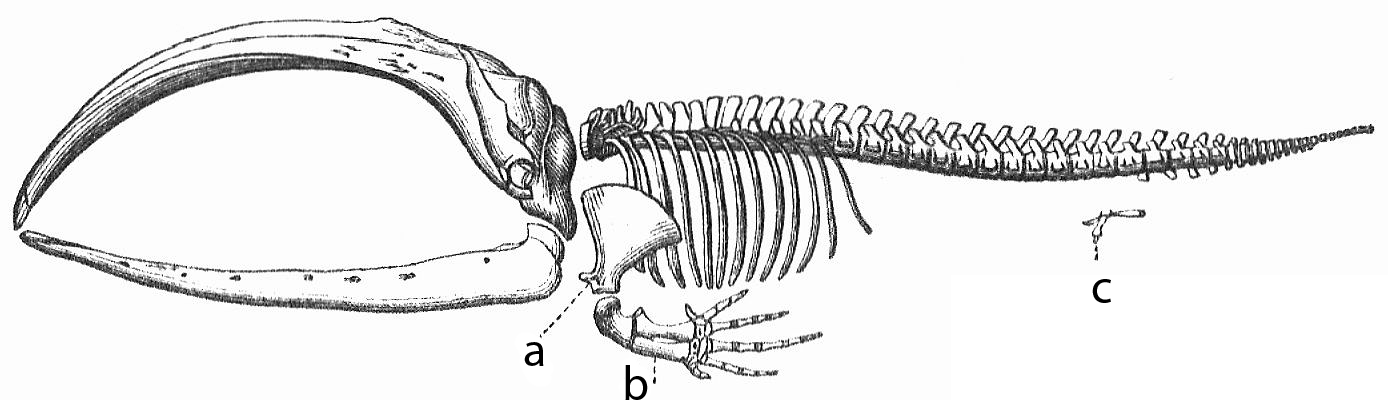
But all of that pseudo-biology aside, what really matters about this is, of course, the thing whose existence is uncertain at best: the mermaid. In their traditional representation, mermaids are "seen" swimming moving their back fin (the fishtail part) up and down, like dolphins and whales, rather than sideways – and, surprisingly, this makes a lot of sense. If they are based on human anatomy, at least partly, it would make very little sense for their skeletal composition to suddenly undergo a complete change as we go from their human part to their fishtail: seeing as their human upper body is depicted as normal, with a spinal cord and ribs, their fishtail would, to make sense, have to be composed like that of a dolphin (or whale, if we're talking about a particularly heavy-set mermaid), with a dorsal spinal cord that extends further than that of humans, all the way down to the feet, which, in this case, are flattened to the state of fins. Imagine a human with two boneless legs sown together (ew) and a very long, straight spinal cord that traverses this sown-together construct, plus two human feet, flattened to they look like fins, with the bones of the feet stretched like gum until they are very thin and serve to give shape to the thin skin of the fin-feet. Or just look at a pretty mermaid.
Either way, all you need to do now is get used to the idea of a pregnant mermaid. Fortunately, it seems it would be much easier for them to regain their figure after pregnancy than for us, what with non-stop workout your abs get simply from swinging your fins up and down.
Staunverbot - Nihil Admirari [Essay/Fiction]
These days, being called “impressionable” is considered an insult in the same right as “gullible”. The impressionable person is one who finds himself in awe when facing an object, concept or experience that is unprecedented within his own conscious universe.
The loss of surprise and wonderment to the more and more common tradition of “unimpressedness”, especially in the academic world, is what Peter Sloterdijk remarks on in the introduction to his essay Streß und Freiheit (2011), and whom he calls “Verblüffungsresistenz” (resistance to bewilderment/astonishment).
The essay as such deals with the conceptual contradiction between the rampant individualism of the West since the emergence of liberal cultures in the 17th century, and the insistence of social sciences to conceive of societies as “constructs”, as political groups driven by the conviction, inherent to its components, that they are somehow bound together by historical, geographical or social causes, by fate or by dedication. However, what struck me about these few opening paragraphs in which Sloterdijk reminds his readers of the increasing rarity, even scarcity, of bewilderment and wonder in the realms of philosophy and social sciences, even though they are often thought, at least in Western philosophy, to underly all contemplative activity (cf. Aristotle, Metaphysics I, 2, 982b.), is the feeling of cynicism, not on Sloterdijk’s part, but one that is very common among students of philosophy especially, and often even picked up on the way as a required personality trait, as though it were, like a Bar Mitzvah, an essential part in the ritual of becoming a fully-fledged philosophical being.
What this leaves on the tongue as an aftertaste is the impression that, if you’re surprised, if you don’t immediately accept as part of the “game” some of the “truths” that were established within the community, you are not doing your job as a doubting entity within said community (paradoxically enough), but rather, you are wasting your time and reputation with doubting things whose existence is fundamental to the very activity of doubt within each of the undercurrents existing within philosophy.
However, it is true that, when partaking in philosophical thought (always an activity drenched in social and historical awareness, no matter how deeply hidden away in your own mind you think you’re operating) doubt and wonder are more acceptable than, say, in the example Sloterdijk pulls from the realm of social sciences, which is their complete acceptance of an established “internal standard”: the existence of “societies”, both as the abstract concept a social structure composed by an accumulation of human beings, and as the very actual, very mind-blowing realisation that, somehow, this multitude of people is composed of willed, conscious individuals who each strive towards the fulfilment of their own life-narrative whilst still managing to remain, more or less, a functioning part of said “society”. The disparateness between individualism [with its sui generis, the obsession with the own unique-snowflakiness] and the integration of the individual within a societal construct that runs on the idea of commonness, is what, in this essay, leads to Sloterdijks proposal of a “Verwunderungsübung” [an exercise in astonishment] against the stream that flows through social and political sciences.
In philosophy, as well as outside of the womb of academia, the cynicism that we are all, to varying degrees, infused with, cuts in two opposite directions: cynicism is both the ad (a very Sartrean) nauseam doubting of all there is, to an almost crippling extent, as well as the stigmatising of those we consider to be “gullible”, based solely on the degree of cynicism we have attained ourselves. We are almost expected, on different levels, to both doubt everything, and to already know everything, a state that can, surely, only be reached through pretence.
************
In the end, it inevitably boils down to cynicism. Cynicism sucks, but it compellingly knocks on your door every time something knocks you down, and after a while it seems like the only reasonable option. It just strikes you as so obvious and irresistible you almost can’t wait for the cynicism to kick in in its full-fledged form and devastate all hope and delicacy (which you associate with weakness at this point anyway) in its way. You’re still in the trial period of the cynicism package you finally succumbed and subscribed to the last time your heart got broken by something ugly. You’re not quite there yet, not bone dry and indestructible, you still occasionally shed a tear or feel your stomach crawl with flying bugs or contract with nerves or hope or love, and you’re impatient, you want to turn into the ice queen you were promised you’d be, this rewarding status you will attain once life has hit you hard enough and chipped away sufficient amounts of your soul. You just have to toughen up and wear the crown one day, you just have to. Even this is a hope, you realise, and you take it back and shut your mouth.
And then one day this girl dies and you go to her house and you go through her things. She killed herself with something easy, pills from what you gather, and after it hit her parents that she was gone they got scared and wanted her things out of their house and out of their lives. They’re staying at a hotel until her traces are removed and her room is turned into a blank slate that can be redecorated into anything they want, anything that will keep them busy enough to forget. You and a few others volunteered to help and so you go through her drawers and you find a notebook filled with her writing, apparently dating from just before her death. You sit down and start reading until someone tells you to get up and keep working, so you slip the notebook in your back pocket, you won’t sell this yet. After a while, the room is clean and you go your separate ways; with a bench under you, you start reading the pages and you read her pain, her broken heart, her loneliness, her disbelief. You understand most of it, though her handwriting gets complex and hard to read whenever her hand starts shaking too much, and you’re pretty sure that smudge above the word “coping” is a tear. The scribblings in the little leather notebook stop abruptly after a while and you’re left feeling an emptiness in your stomach that doesn’t surprise you even though you had lunch just an hour ago because nothing surprises you much these days. You understand. Her pain was there, stronger and more all-encompassing than she was prepared for, and she felt the logical progression from being left by someone who was everything lay in leaving everything else that was left to leave. Her life, the world. Her pain was there, too much of it, and now she’s gone and for all you know the pain is too. But you’re not sure of that. The pain is right there in the little leather notebook, unused otherwise but for a few pages of Spanish vocabulary.
Your friend has a gallery, so you photocopy the pages, you transcribe some excerpts to increase their legibility, you resize, you crop, you frame. On opening night, the spotlights are tasteful and the people shuffle through the room, bubbly wine in hand from which they sip as they read, in constant gliding motion, never coming to a full stop no matter how compelling the reading. You gave them real pain, so simple and futile in its commonness, they’re drinking it up with the bubbly wine because it’s real and it has a sad backstory to prove it. “It’s so sad, really, these kids, how seriously they take things…” says a woman. She’s tall, think, gangly, she tries so hard to stay young. You pace through the room, some people smile at you, some pat you on the back and say “very touching, very moving”. They smile and you bare all your teeth for them. You feel naked when you smile. You go into the back and adjust a spotlight that was crooked. The black ink jumps out at the room and the words on the page come to life again. “Love the concept”, says one busy voice to another as they’re rushing by. You gave them the pain they hate to feel, the pain they find ridiculous, and you provided them with an opportunity to walk away from it. Later tonight, they all will, and, after a glass of celebratory wine, so will you.
************
Here are the pages you took from the notebook and hung on the wall for all to see:
Strangely enough, I never thought I’d have to get over you. I’ve thought about it, what it would be like, but whenever I did it was so abstract, almost an exercise in conjuring up feelings that I could let go as soon as reality, namely the fact that you really were there, kicked back in. Now you’re gone for good, no hope as to your return, no more sitting on my floor holding me and telling me you love me and that we’re worth the trouble… it’s as hopeless as if you were dead, but it’s worse because you’re not. Your feelings for me won’t return and stay for good, yet the million ghosts of you I’ve gathered swarm around me each of them carrying an absurd speck of hope like a disease.
If you were dead, I’d stop hoping. If you were dead, you wouldn’t be able to go on, to forget me little by little, to fall in love with someone else, someone better, someone who will end up destroying your promise (“if it doesn’t work with you, I don’t want it to work with anyone”) once and for all. It’d be easier. I wouldn’t have to live with the knowledge that you are fine without me. That you don’t look back or miss me, when everything about me used to be saturated with you. You meant much, much more to me than I realised. And now I’m abandoned without a clue as to how to go on.
Writing helps. Gives the whole thing momentary abstraction. The words only stand for the pain. But at the same time, I feel how desperate the situation is. I’ll never be able to write about a broken heart in a way that feels real. And everyone has had their heart broken anyway, who cares. Everyone is alone with their pains.
The mere idea that you will be fine and I won’t, that you will get over me, that you already are, that you will fall in love with someone who means to you what you mean to me… it sickens me to a point where I feel so helpless and disgusted that I just want the world to shut down and start again at a point where things were still good. Where there still was an “us”. I keep thinking I met you too early. Or at the wrong time, anyway, under the wrong circumstances. That, had all this been right, I’d have meant to you what you mean to me, and you’d still love me with all your being. And then, I start hoping that you’ll come back, realise that you do love me and never leave me again.
But all I can do is rid myself of this hope. You won’t come back. There is no going back from the curse of friendship, from the loss of feelings or love. I’ll never be to you what you were to me. I think it’s this unfairness that kills me. No matter how much I suffer, no matter how I feel now, you’ll be fine, better off, you’ll heal & forget me quickly, unaware and uncaring. So all I can do, really, is let myself forget about you – about the love of my life.
Another night of despair and it keeps growing. I’m afraid I might associate my bed, my own bed, with this pain. This fear of having lost what was most precious to be. And of having lost it irrevocably because there is no merciful power that will make him love me the way I love him. And the more I think about it, the more painful this realisation becomes. I won’t ever mean to him what he means to me. Someone else will, I suppose.
And my feelings won’t seem to fade. And how could they? Some part of me probably still treasures them. The love of my life, at 20? I so yearn to explain those feelings to him. To have him, if only for an instant, feel what I feel for him. Understand what he’s done to me and what he’s wasting, throwing away. I am angry at so much unfairness and… I’d say cruelty if I believed such a force actually has a hand in things.
I’m afraid. Of the future. Of my coping with having lost him, of him being fine and me devastated. Of the loneliness and the dark days, of never finding anyone to bond with, of never being able to sleep again. Of destroying myself with this pining. Of wasting my youth. Of never loving like this again. Of loving like this (again). Of being hurt. I cannot think straight. I still think of him so often and with every passing hour he probably thinks less and less about me. And there’s nothing I can do to stop this decay.
23 September 2012
Arte Metropolis – Luxembourg
Ah, Lëtzebuerg, eternally wedged between borders, though in this short documentary about the luxembourgish art scene featured on arte's programme Metropolis, these borders are temporal rather than spatial: 6:07 – 18:40 (French and German)
Subscribe to:
Posts (Atom)


 Posts
Posts

