I'm not sure how this occurred, but on our way into town this morning, the conversation that usually accompanies our walks turned from the physical (sharks and crocodiles, and why they're aesthetically vile, on top of being nothing but stomachs with teeth) to the fantastical, namely mermaids and why they're clearly mammals. Though this is more of a debate you have late at night when you run out of ideas and less nerdily whimsical topics to discuss, I have often had to listen to people loudly (fuelled by wine) exclaim that mermaids, if they existed, would fall under the category of fish, with a reproductive system to match. This theory never appealed to me, perhaps due to a mammalian narcissism, perhaps because it seems wrong that something based so closely on human proportions would lay eggs and produce offspring counting anywhere between two and three digits, and I kept insisting that mermaids have wombs.
And today, it finally occurred to me why this was closer to making sense than I thought: it was pointed out to me that sharks move their rear fins sideways, like most fish (excluding those flat ones that dwell on the bottom of the sea like predatory pancakes), but that sea-mammals, like whales and dolphins, wag their tails up and down, fanning the water like ancient Egyptian servants as they swim.

The reason this is so, we figured (we could probably have read this up in any book on marine biology, but we didn't have one at hand, so guessing was the best we could do), is because fish have a skeleton much different to that of mammals: they do not need to accomodate a womb like we do, and their skeletons go straight through their bodies, almost as though they were on a skewer, with bones sticking up and down, which means that a sideways motion makes the most sense for them.

For mammals, however, such a motion would prove very difficult, even underwater, as their skeleton is mostly dorsal, i.e. located along their backside. Additionally, whales, as well as dolphins, don't seem to have bones in their rear fins, whereas sharks do; mammalian rear fins therefore seem to really function according to more of a fanning mechanism, used for propelling and steering, whereas those of fish, along with propelling, might serve more of a directional function, like a rutter on a boat.

But all of that pseudo-biology aside, what really matters about this is, of course, the thing whose existence is uncertain at best: the mermaid. In their traditional representation, mermaids are "seen" swimming moving their back fin (the fishtail part) up and down, like dolphins and whales, rather than sideways – and, surprisingly, this makes a lot of sense. If they are based on human anatomy, at least partly, it would make very little sense for their skeletal composition to suddenly undergo a complete change as we go from their human part to their fishtail: seeing as their human upper body is depicted as normal, with a spinal cord and ribs, their fishtail would, to make sense, have to be composed like that of a dolphin (or whale, if we're talking about a particularly heavy-set mermaid), with a dorsal spinal cord that extends further than that of humans, all the way down to the feet, which, in this case, are flattened to the state of fins. Imagine a human with two boneless legs sown together (ew) and a very long, straight spinal cord that traverses this sown-together construct, plus two human feet, flattened to they look like fins, with the bones of the feet stretched like gum until they are very thin and serve to give shape to the thin skin of the fin-feet. Or just look at a pretty mermaid.
Either way, all you need to do now is get used to the idea of a pregnant mermaid. Fortunately, it seems it would be much easier for them to regain their figure after pregnancy than for us, what with non-stop workout your abs get simply from swinging your fins up and down.
And today, it finally occurred to me why this was closer to making sense than I thought: it was pointed out to me that sharks move their rear fins sideways, like most fish (excluding those flat ones that dwell on the bottom of the sea like predatory pancakes), but that sea-mammals, like whales and dolphins, wag their tails up and down, fanning the water like ancient Egyptian servants as they swim.
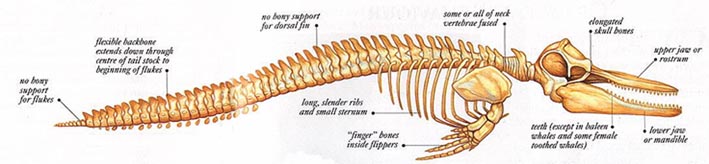
The reason this is so, we figured (we could probably have read this up in any book on marine biology, but we didn't have one at hand, so guessing was the best we could do), is because fish have a skeleton much different to that of mammals: they do not need to accomodate a womb like we do, and their skeletons go straight through their bodies, almost as though they were on a skewer, with bones sticking up and down, which means that a sideways motion makes the most sense for them.

For mammals, however, such a motion would prove very difficult, even underwater, as their skeleton is mostly dorsal, i.e. located along their backside. Additionally, whales, as well as dolphins, don't seem to have bones in their rear fins, whereas sharks do; mammalian rear fins therefore seem to really function according to more of a fanning mechanism, used for propelling and steering, whereas those of fish, along with propelling, might serve more of a directional function, like a rutter on a boat.
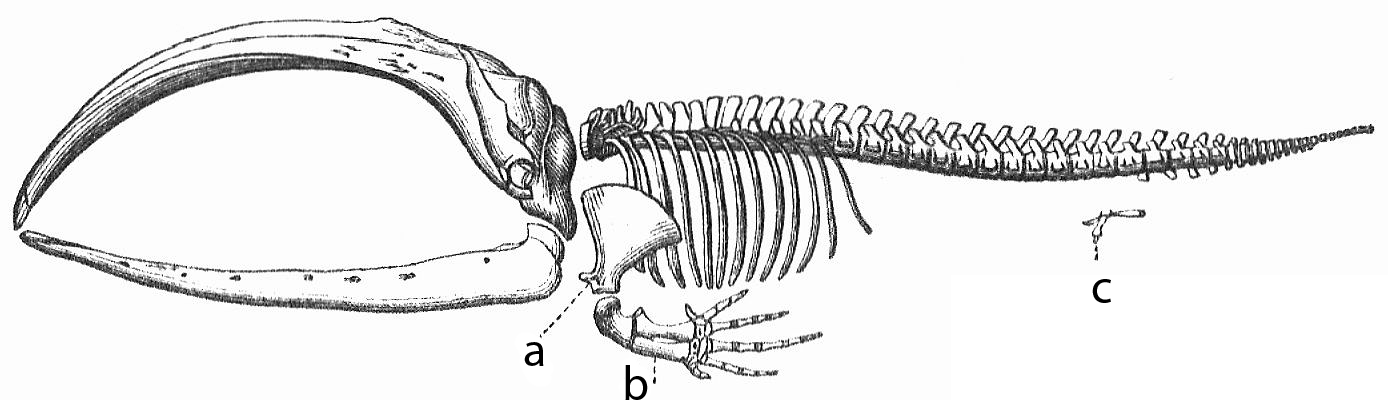
But all of that pseudo-biology aside, what really matters about this is, of course, the thing whose existence is uncertain at best: the mermaid. In their traditional representation, mermaids are "seen" swimming moving their back fin (the fishtail part) up and down, like dolphins and whales, rather than sideways – and, surprisingly, this makes a lot of sense. If they are based on human anatomy, at least partly, it would make very little sense for their skeletal composition to suddenly undergo a complete change as we go from their human part to their fishtail: seeing as their human upper body is depicted as normal, with a spinal cord and ribs, their fishtail would, to make sense, have to be composed like that of a dolphin (or whale, if we're talking about a particularly heavy-set mermaid), with a dorsal spinal cord that extends further than that of humans, all the way down to the feet, which, in this case, are flattened to the state of fins. Imagine a human with two boneless legs sown together (ew) and a very long, straight spinal cord that traverses this sown-together construct, plus two human feet, flattened to they look like fins, with the bones of the feet stretched like gum until they are very thin and serve to give shape to the thin skin of the fin-feet. Or just look at a pretty mermaid.
Either way, all you need to do now is get used to the idea of a pregnant mermaid. Fortunately, it seems it would be much easier for them to regain their figure after pregnancy than for us, what with non-stop workout your abs get simply from swinging your fins up and down.


 Posts
Posts

